The Morgan Picture Bible

Crusader Bible (MS M.638) • ca. 1244–1254 • Paris, France

« Back to the manuscript

The Colors of the Crusader Bible

When you look at a page from the Crusader Bible, you are not just looking at a painting — you are looking at a small fortune. Every colour on the vellum came from somewhere specific on the medieval world map: a single mine in the mountains of Afghanistan, a reef in the Mediterranean, a vein of copper in the Alps, a swamp plant in Persia. Many of the pigments were toxic. Several were literally worth more than gold. All of them had to be prepared by hand before the illuminator could even begin.

The twelve pigments below are the main colours you see in MS M.638. Each card shows the finished colour, the raw material it came from, where the name comes from, and what it took to turn a rock, a plant, or an animal into paint.

Blues

#120A8F

Ultramarine

from lapis lazuli · Na8[Al6Si6O24]S3
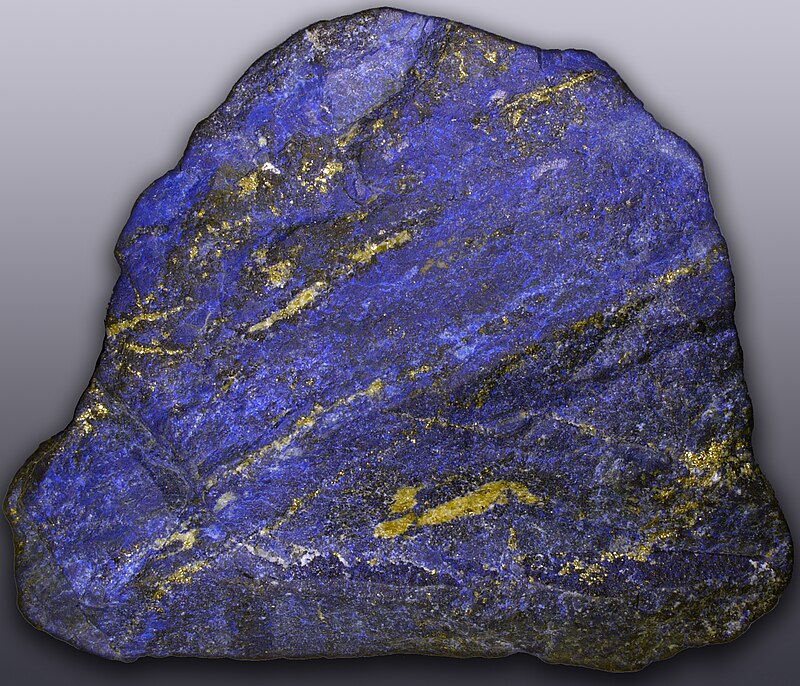
Raw lapis lazuli stone with deep blue and white calcite veins
Raw lapis lazuli. The blue colour comes from the mineral lazurite; the white flecks are calcite, the gold specks are pyrite.

The name. Ultramarine is Latin for “beyond the sea”. In medieval Europe, the pigment had to literally come from beyond the sea — specifically across the Mediterranean from the mines of Afghanistan. The word first shows up in Italian artists' manuals around 1400, in Cennino Cennini's Il Libro dell'Arte, where he calls it “the most perfect colour one could find.”

Where it came from. For most of the Middle Ages there was effectively one source on Earth: the Sar-i Sang mines in the Hindu Kush mountains of northeastern Afghanistan. The raw stone travelled west along the Silk Road, through Persian and Arab traders, onto ships in the eastern Mediterranean, and finally into the workshops of Venice, Paris and Bruges. By the time a lump of it reached a French scriptorium, it had been handled by dozens of people across six thousand kilometres.

The cost. Extracting the pure blue was hideously slow. The crushed stone was kneaded with wax, resin and oil into a dough, then repeatedly washed in lye — only the deepest, purest particles came out on the first wash, and each successive wash yielded weaker grades. A pound of top-grade ultramarine could cost more than a pound of gold. In the 19th century, just before it was finally synthesised, Parisian dealers were asking up to 5,000 francs for a single pound. Medieval contracts sometimes specified, to the gram, how much ultramarine a painter was allowed to use — and most of it went on the robes of the Virgin Mary.
#2E5894

Azurite

copper carbonate · Cu3(CO3)2(OH)2

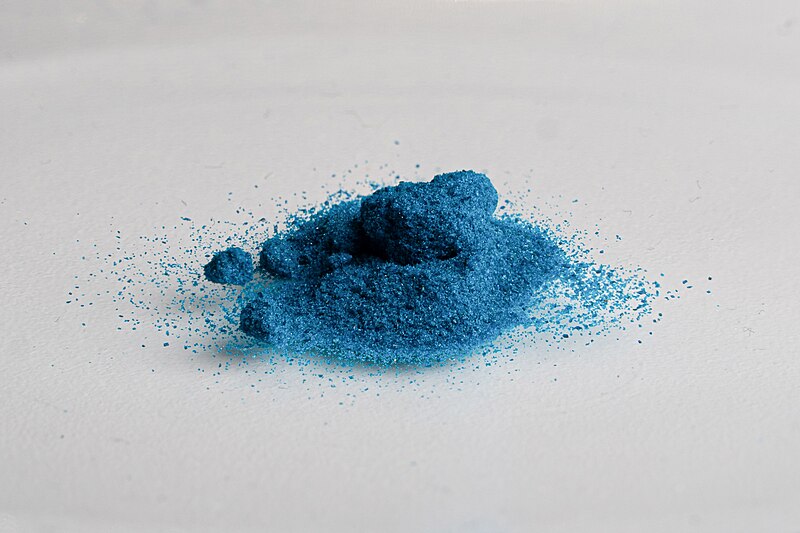
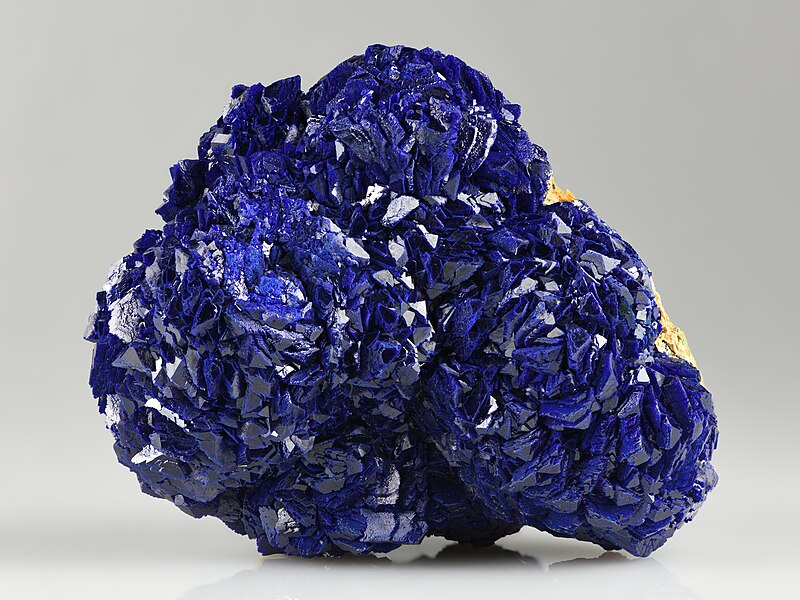
Deep blue crystals of azurite mineral
Azurite crystals. The mineral forms where copper ore has weathered in the presence of carbon-dioxide-rich water.

The name. Azurite comes from the Persian word lāzhuward, “blue”, travelling through Arabic al-lazuward into Latin azura. The same root gives us the English word “azure” and the lazuli in lapis lazuli. Persian blue, in other words, is the ultimate source of the European word for blue.

The cheaper blue. Azurite was the workhorse blue of medieval illumination. It was mined across Europe (notably in Germany, Hungary and France) rather than halfway around the world, which made it dramatically cheaper than ultramarine. A monastic scriptorium that could not justify ultramarine for an entire manuscript would use azurite for everything except the most sacred figures, reserving the Afghan blue for the Virgin's cloak or the sky above a crucifixion.

The catch. Azurite has a nasty habit: exposed to moisture or heat for long enough, it slowly converts to the green copper mineral malachite. Many medieval paintings that look greenish today were originally a vivid blue. The pigment is also gritty: it must be ground coarsely or it turns pale, so azurite passages look slightly glittery compared to the smooth, deep ultramarine.

Reds & Oranges

#E34234

Vermilion

from cinnabar (mercury sulfide) · HgS

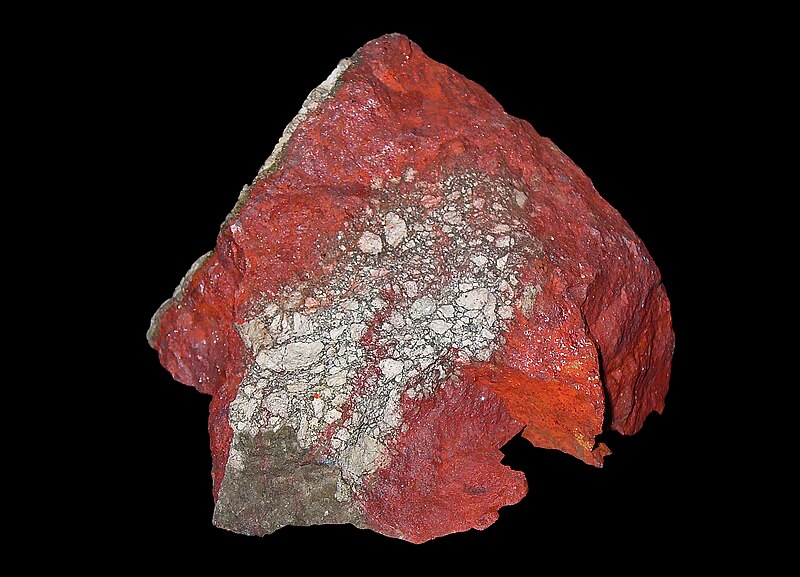
Brick-red cinnabar ore on rock matrix
Cinnabar — the brick-red ore of mercury. Cinnabar is one of the densest common minerals (eight times heavier than water).

The name — a surprise. Vermilion has nothing to do with mercury. The word comes from Latin vermiculus, “little worm” — it originally referred to a brilliant red dye made from the crushed bodies of the kermes insect (Kermes ilicis), harvested from Mediterranean oak trees. Throughout the early Middle Ages, “vermilion” meant bug red. It was only around the 13th–14th century, as illuminators adopted ground cinnabar for its unmatched brilliance, that the name quietly migrated from the insect dye to the mineral pigment. The new vermilion was so close in hue that the old name simply came along.

Where it came from. For medieval Europe, the main source was Almadén in central Spain, whose mercury mines had been worked since Roman times. Ground cinnabar produces an opaque, fiery red-orange with no rival in the natural mineral world. Illuminators used it for flesh highlights, for the red lines that rubricate important words in a manuscript (the rubrics, from rubrum, “red”), and for bright accents.

The danger. It is mercury sulfide. Grinding and mixing it released fine mercury dust, and the finished paint was, and still is, extremely toxic. Medieval workshops knew that cinnabar workers sickened unusually often — though they had no word for what we now call heavy-metal poisoning.

#E25822

Minium (Red Lead)

lead tetroxide · Pb3O4

Bright orange-red powder of minium (red lead)
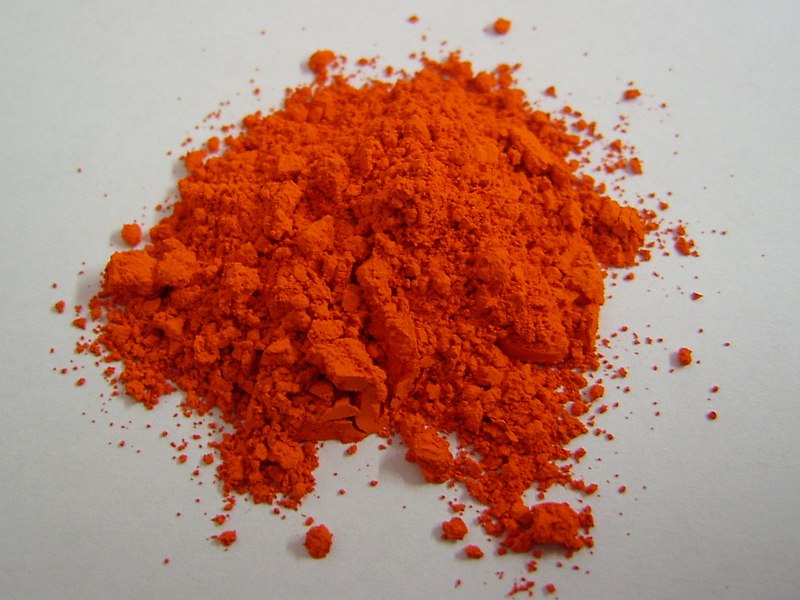
Red lead powder — lead metal roasted in air until it oxidises to a brilliant orange-red.

The name that named “miniature”. This is the pigment that gave us an everyday English word. The Latin minium was originally the Roman name for cinnabar, but as red lead replaced true cinnabar in the cheap end of the market, the name followed the new, more affordable material. Scribes used red lead for small decorated letters and borders in manuscripts, and the act of painting with minium was called miniare. A miniatura was literally “a small thing painted with minium”, and that word slid in English into miniature — meaning any small painting, and eventually anything small at all.

Made, not mined. Unlike almost every other pigment on this page, minium was a manufactured chemical. You took metallic lead, heated it in air until it turned to yellow lead oxide (litharge), then kept roasting it until it oxidised further into the brilliant orange-red Pb3O4. Pliny the Elder described the process in the 1st century CE. It was cheap and reliable — every medieval workshop could produce it in a simple hearth.

The catch. Like all lead pigments, it is toxic. It is also chemically unstable in contact with certain other pigments, sometimes darkening to brown or black lead dioxide where moisture reaches it. Some places in early manuscripts that look like dark brown shadows were originally a brilliant orange.

#A8132B

Madder

from Rubia tinctorum root · alizarin (C14H8O4)

Rubia tinctorum plant showing whorled leaves and small yellowish flowers
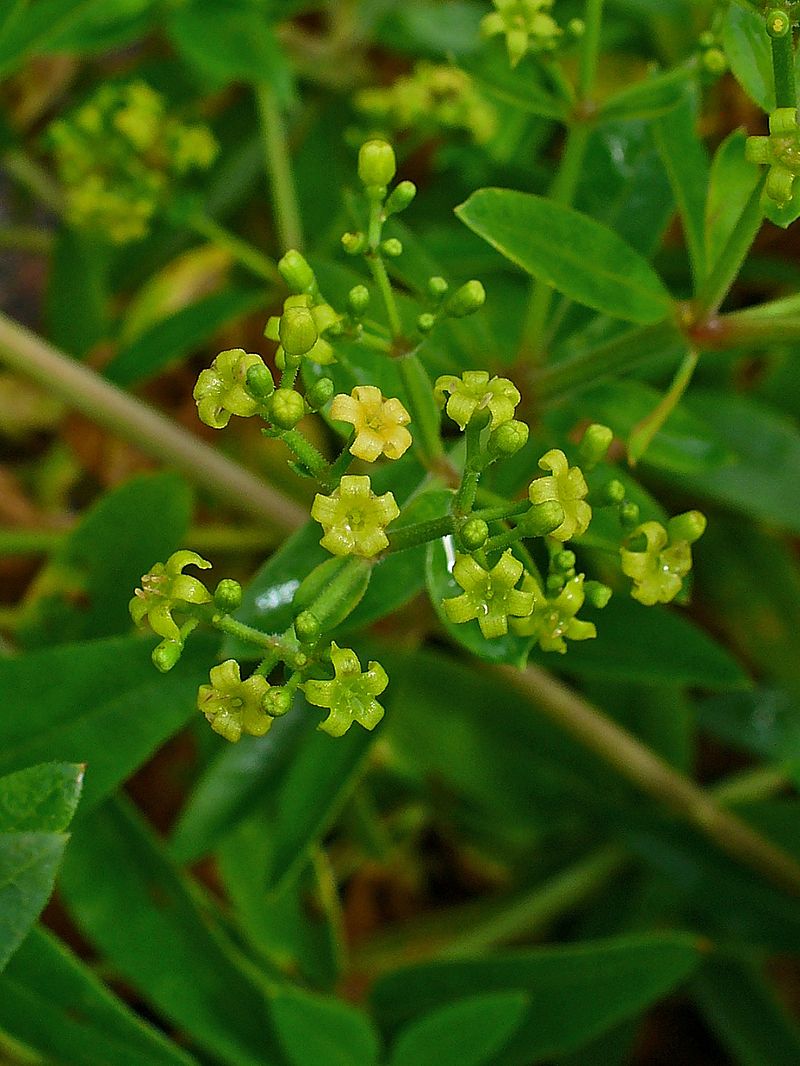
Rubia tinctorum, dyer's madder. The red pigment is in the long taproot, not the leaves or flowers.

The name. Madder comes straight from Old English mædere, the ancient Germanic name for the plant itself — one of those rare pigment words that never borrowed from Latin or Greek. The Latin name Rubia, which you still see in the plant's scientific name, means simply “red”.

A plant that makes red. Dyer's madder is a scrambling perennial native to the Mediterranean and western Asia. You grow it for two or three years, then dig up the long taproot — the red is concentrated there. The roots are dried, ground, and soaked in water to extract alizarin, an anthraquinone molecule that binds easily to cloth fibres and, when fixed on a chalk or aluminium base, forms a deep crimson “lake” pigment for painting.

In the manuscript. Where ultramarine and vermilion are mineral and opaque, madder lake is organic and translucent. Illuminators used it for the glowing, glaze-like reds of cloaks and blood, and mixed it with other pigments to shift their temperature. Madder is also the reason the British army wore red coats for three hundred years — the same dye, just on a bigger scale.

#66023C

Tyrian Purple

from sea snails · 6,6′-dibromoindigo

Shell of Bolinus brandaris, the spiny dye-murex sea snail
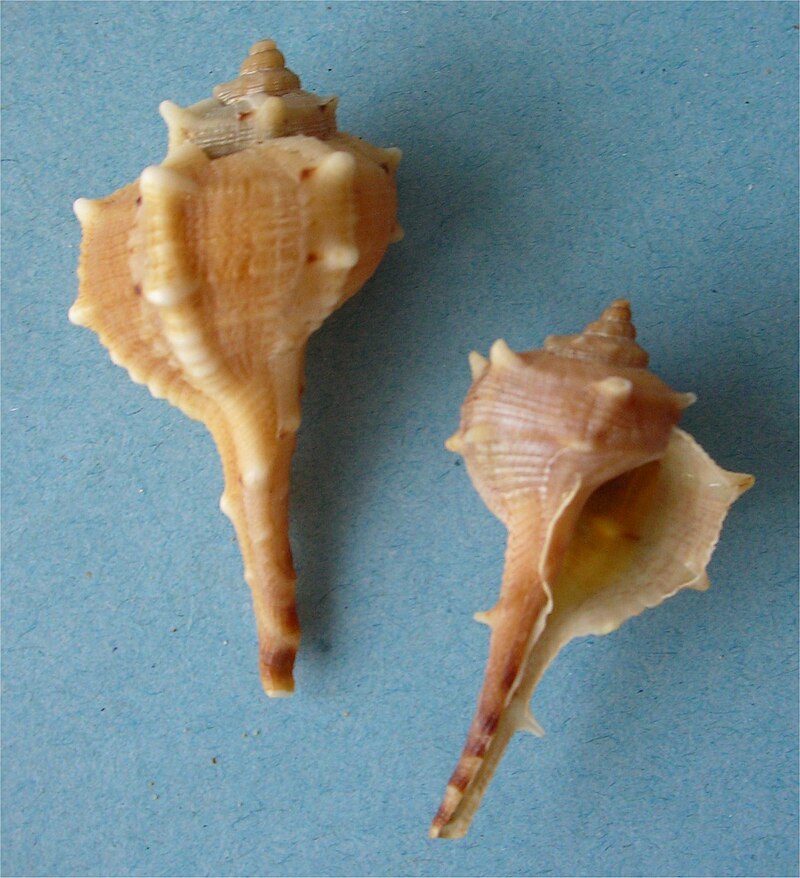
Bolinus brandaris, the spiny dye-murex. A small gland inside the living animal produces the precursor to Tyrian purple.

The name. Tyrian comes from the ancient Phoenician city of Tyre (in modern Lebanon), whose dyeworks were famous across the Mediterranean world. The Greeks called the whole region Phoinikē — Phoenicia — and the usual theory is that the name itself comes from phoinix, the Greek word for “purple”. The colour was so associated with the place that it may literally have named it.

Twelve thousand snails. Each Bolinus brandaris yields only a tiny drop of the colourless precursor fluid from its hypobranchial gland. Exposed to sunlight and air, that fluid slowly oxidises through green, to blue, to the final deep reddish-purple. One estimate, repeated since antiquity, says it took around twelve thousand snails to produce a single gram of dye. Even at conservative figures it took tens of thousands.

The price of emperors. By weight, Tyrian purple was worth more than gold throughout the Roman period. Roman sumptuary laws eventually forbade anyone below the rank of emperor to wear a fully purple garment — “born to the purple” became shorthand for being royal. It was also notoriously foul-smelling in production (the snails rot) and the dyeworks had to be sited downwind of the city. By the time the Crusader Bible was made, the fall of Constantinople in 1204 had already disrupted the industry; true Tyrian purple was by then a relic, and most medieval “purples” on vellum were actually mixtures of ultramarine with a red like madder.

Greens

#0B6623

Malachite

copper carbonate · Cu2(CO3)(OH)2

Banded green malachite mineral
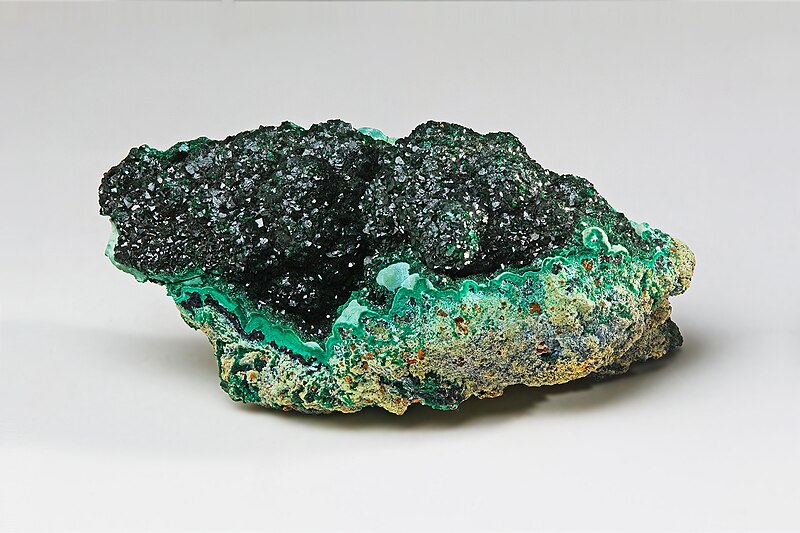
Banded malachite from the copper belt of central Africa. The characteristic stripes come from successive layers deposited in underground voids.

The name. Malachite comes from Ancient Greek malachē (μαλάχη), “mallow”, after the plant. To Greek eyes, the stone looked the same shade of deep, slightly dusty green as mallow leaves, so the name stuck. It has remained unchanged for over two thousand years.

Azurite's cousin. Malachite and azurite form in the same place — the weathered oxidation zone above a copper ore body — and are often found intergrown in the same lump of rock. Malachite is chemically just a more hydroxide-rich, less CO2-rich version of azurite. Over the long term, in a wet environment, azurite will spontaneously turn into malachite, which is why so many medieval blue skies have drifted towards green.

Use. Ground to a coarse powder, malachite gives a cool, slightly bluish green. Like azurite it has to be kept coarse or it fades to pale; and like azurite it was cheaper than mineral alternatives, which made it the everyday green of European manuscript art until the Renaissance brought in new synthetic greens.

#43B3AE

Verdigris

basic copper acetate · Cu(CH3COO)2·Cu(OH)2·2H2O

Blue-green crystalline copper acetate
Basic copper acetate crystals — the green-blue deposit you get when copper corrodes in the presence of vinegar.

The name. Verdigris comes from Old French vert de Grece, literally “green of Greece”. Nobody is entirely sure why — one theory is that the best copper for the process came from Cyprus (Kypros, which gave its name to cuprum, copper) and Cyprus was part of the Greek-speaking world. The Italians cheerfully called it verde rame, “copper green”, and the Germans called it Grünspan, “green span” — both more literal, both less poetic.

Made in a jar of vinegar. Unlike malachite you did not mine this green — you made it. The standard medieval recipe was to suspend copper strips inside a closed clay pot over hot vinegar and let the acetic-acid vapours slowly corrode the surface. After a few weeks you scraped off the crystalline blue-green crust and started again. Pliny the Elder described the method in the 1st century. The town of Montpellier in southern France became so good at it that “Montpellier verdigris” was an export product in its own right well into the 18th century.

In the manuscript. Verdigris made a vivid, transparent green that was perfect for foliage and glazing over other colours. Unfortunately it is also mildly acidic, and over centuries it eats into the parchment beneath it — you can sometimes see verdigris green passages in old manuscripts that have literally burned through the page.

Yellow

#FFC412

Orpiment

arsenic sulfide · As2S3

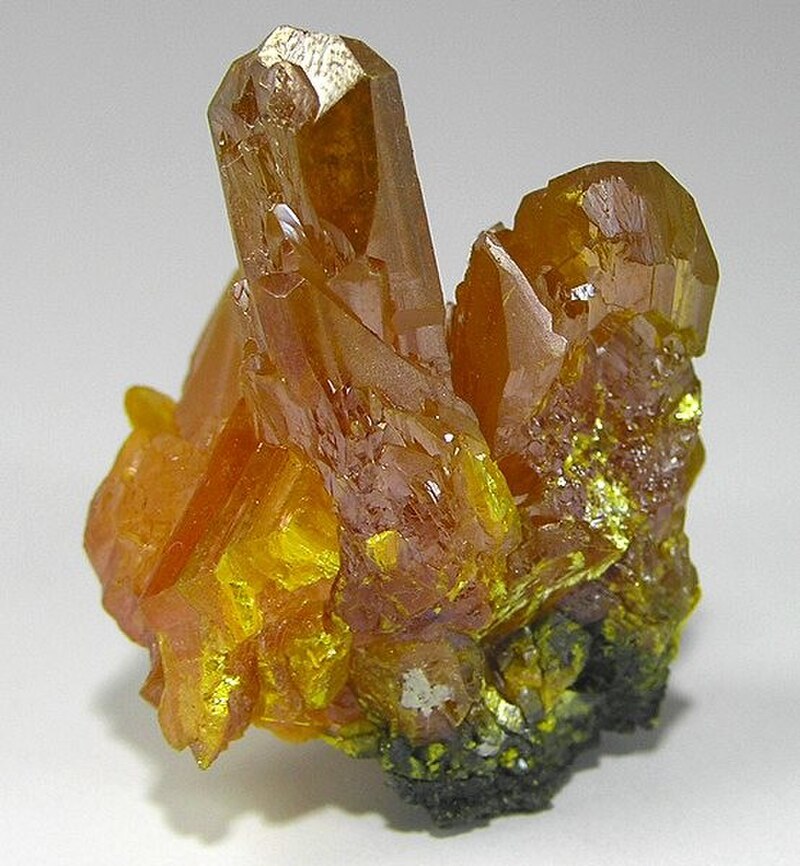
Golden-yellow orpiment mineral crystals
Orpiment — a naturally golden-yellow mineral of arsenic and sulfur. The colour is extraordinary; the toxicity is worse.

The name. Orpiment is a compressed form of Latin auripigmentum, literally “gold pigment” (aurum “gold” + pigmentum “paint”). The Romans saw a yellow mineral that glowed like gold and named it accordingly. The Persian name zarnīkh means the same thing: “gold-coloured”. The Greek word arsenikon, from which we get arsenic, also came from this mineral; chemists kept the Greek word and invented the modern concept of arsenic the element long after the pigment had been in use.

The pigment that kills everything. Orpiment is arsenic trisulfide, one of the most toxic materials routinely used in pre-modern art. Grinding it released arsenic dust. Any painter working with it over years was slowly poisoned. It also reacts with almost every other pigment on this page — it blackens lead white, it destroys verdigris, it discolours cinnabar. Medieval recipe books warn against mixing orpiment with other colours and recommend keeping it in its own dedicated grinding dish.

Used anyway. Nothing else in the medieval palette matched its saturated, slightly greenish lemon-gold. For passages where the illuminator did not want to spend real gold leaf — haloes in less important figures, decorative flourishes, the yellow of a sulfur flame in a hell scene — orpiment was worth the poisoning risk.

White

#F5F5EA

Lead White

basic lead carbonate · 2 PbCO3 · Pb(OH)2

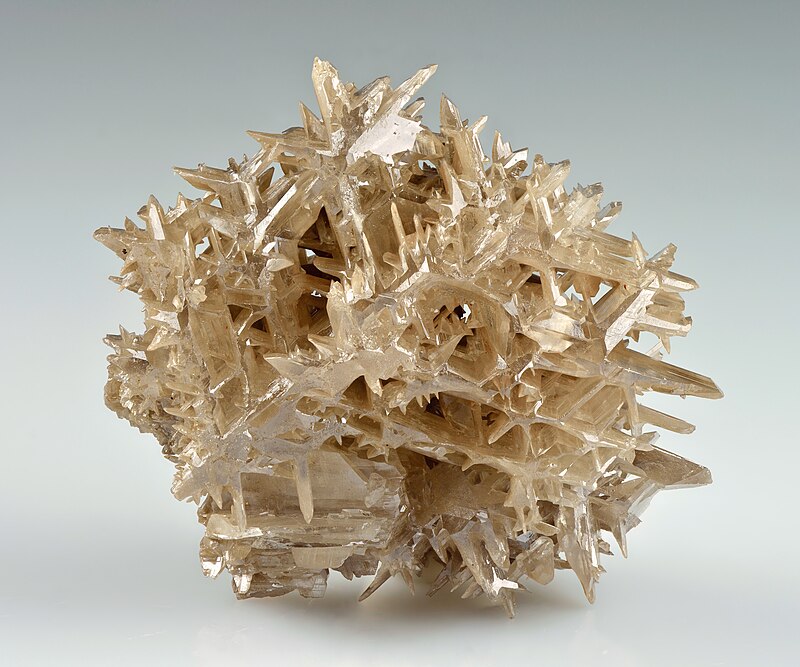
White cerussite mineral - lead carbonate
Cerussite — naturally occurring lead carbonate. The synthetic version, made by corroding lead with vinegar, was the standard white pigment for two thousand years.

The name. The English name is flatly descriptive: lead white is white paint made from lead. Latin called it cerussa (from which the mineral cerussite takes its name), and medieval alchemists sometimes called it psimythium or blacca. Unlike most pigments on this page, the word does not travel through exotic languages — because the material itself was made at home, in every city with a lead supply.

The Stack Process. For centuries the standard recipe was beautifully simple and beautifully gross. You coiled lead strips into clay pots, poured vinegar in the bottom, and buried the pots in a heap of fermenting horse manure or spent tan-bark. The combination of vinegar vapours, warmth, and the carbon dioxide released by the fermentation slowly corroded the lead into a white crust of basic lead carbonate. Every few months you dug the pots out and scraped off the pigment. This “stack process” was still in industrial use in the 19th century.

In the manuscript. Lead white is dense and opaque; you only need a thin layer to cover other colours. It was the illuminator's go-to for highlights on skin, for clouds, for folds in white robes, and for underpainting brighter colours to make them pop. It is also, like every lead pigment, poisonous — and it darkens on exposure to sulfur, which is why old paintings sometimes have mysterious black spots where a highlight used to be.

Gold

#D4AF37

Gold Leaf

pure gold, beaten to one ten-thousandth of a millimetre

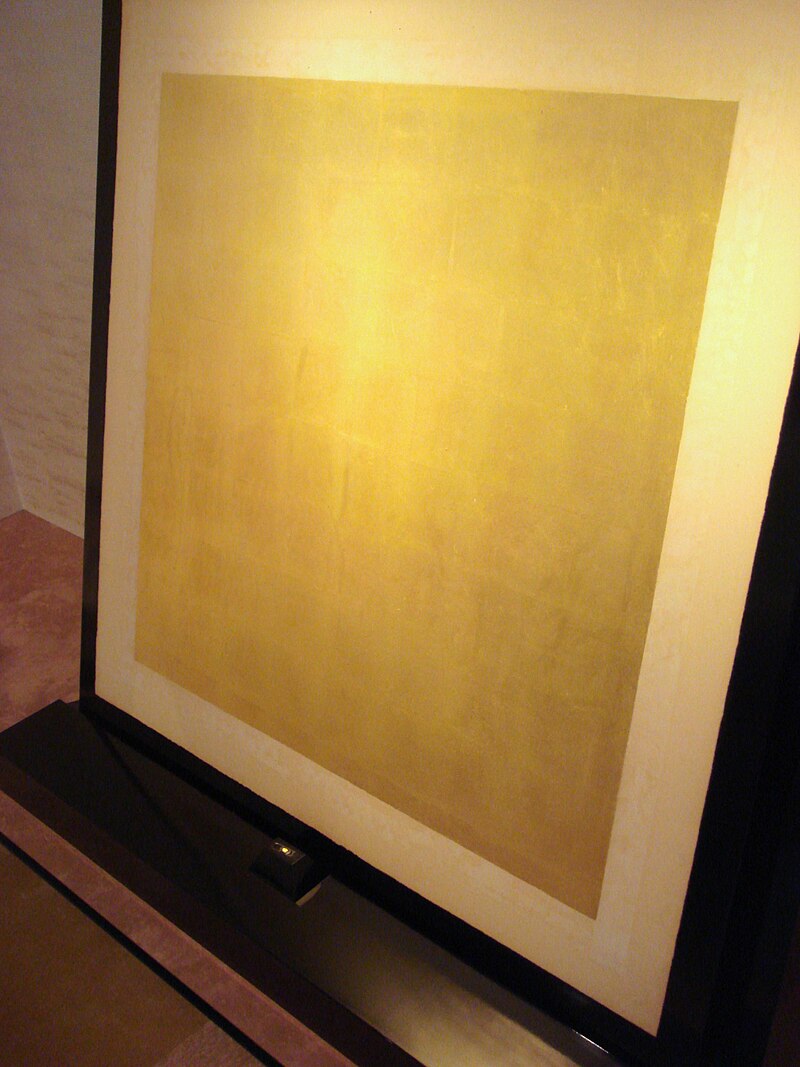
Small gold nugget and gold leaf
A 5 mm gold nugget and, behind it, the half-square-metre sheet of gold leaf it can be beaten into.

Not a pigment. Strictly, gold leaf is not a paint — it is metal, applied in sheets. But no account of the Crusader Bible's colours is complete without it, because the burnished gold backgrounds and haloes are as much a part of the look of the manuscript as any blue or red.

How thin is gold leaf? About 0.1 to 0.2 micrometres — a ten-thousandth of a millimetre. That is thin enough to be translucent: hold a sheet up to the light and it looks green. A single gold nugget the size of a pea can be hammered into a sheet that covers half a square metre of vellum. Medieval goldbeaters worked between sheets of parchment or vellum to keep the metal from tearing.

How it got onto the page. Manuscript gold was applied over a sticky ground called gesso or bole — a mix of chalk, plaster, sugar and red earth that was painted onto the vellum and allowed to dry. The illuminator breathed onto the ground to raise moisture, pressed the gold leaf onto it, and then burnished it with a dog-tooth or a polished agate until it became a mirror. In the Crusader Bible, the haloes and backgrounds have this burnished quality: tilt the page and they flash like metal. Throughout the ancient world gold had been “the flesh of the gods”; in a Christian manuscript it stood for divine light.

Black — the Ink

#1A110A

Iron Gall Ink

from oak apples · iron(II/III) gallate

Oak apple gall growing on an oak branch
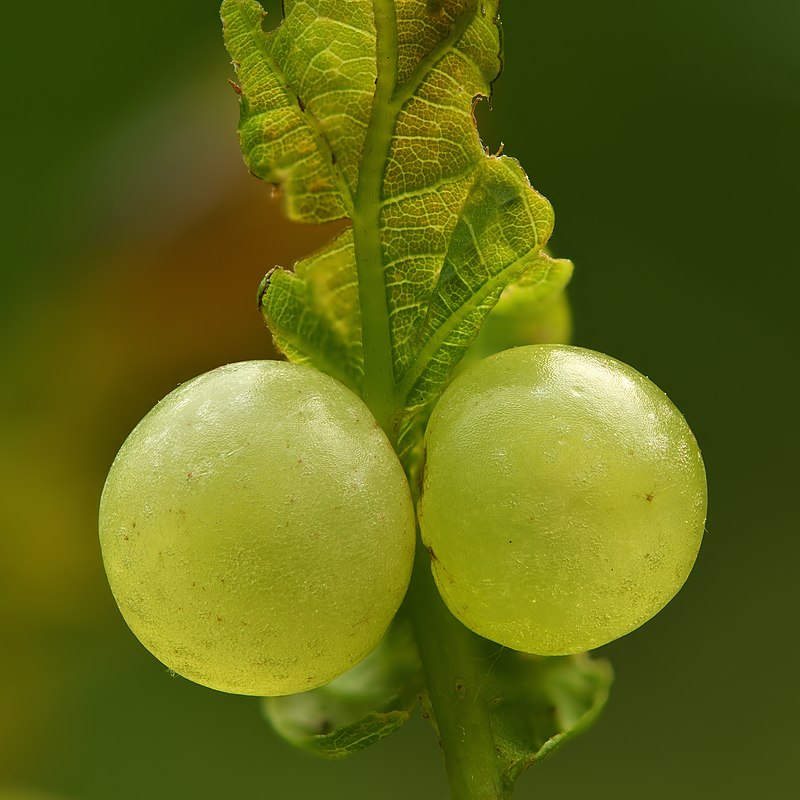
An oak apple. The round gall is the tree's reaction to a wasp egg laid in a young bud; it is rich in tannic and gallic acid.

The writing of the Middle Ages. Almost every word of Latin text in the Crusader Bible was written in iron gall ink — the ink that made European literacy possible for a thousand years. It was not a pigment in the painted sense; it was a chemical reaction on the page.

From a wasp, a tree, and a rusty nail. The first ingredient is an oak apple. When a tiny gall wasp (Biorhiza pallida) lays an egg in the bud of an oak, the tree reacts by growing a round, spongy gall around it. These galls are rich in gallic acid and tannins. You crushed them, soaked them in water or wine, then added iron(II) sulfate — green vitriol, made from oxidised iron. The combination of tannin and iron forms a colourless solution that turns black on contact with air as the iron oxidises. That is why medieval ink darkens as it dries.

Why it fades into brown. If you look at old manuscripts, including parts of the Crusader Bible, the ink is often a warm dark brown rather than true black. That is not fading — it is continued oxidation. The same reaction that turns the ink black in the first minutes keeps going across centuries, slowly shifting the iron-gallate compound towards rust-brown. Strong iron gall ink can also eat through the parchment beneath it, the same way verdigris does, which is one of the great preservation headaches of medieval manuscripts.

Where this information came from

The historical and chemical facts on this page were compiled from Wikipedia and cross-checked against Grokipedia, with primary sources including the WebExhibits Pigments Through the Ages database, the CAMEO materials database at the Museum of Fine Arts Boston, Cennino Cennini's Il Libro dell'Arte (c. 1400), and Pliny the Elder's Naturalis Historia (c. 77 CE).

Image credits

All photographs of source materials are from Wikimedia Commons and are reproduced here under their respective free licences. Click a source name below to open the original Wikimedia Commons page with full author and licence details: